


AI & EntrepreneurshipCollege
Entrepreneurship as a systemic achievement, not a product of chance. State-accredited, fully digital entrepreneurship - integrated across every degree program.
- 12
- Integrated degree programs
- 100+
- Startups targeted by 2030
- 50+
- Countries in the founder community
- 100%
- Fully online delivery
Three pillars of the College
Digital delivery, AI-native learning, and cross-program teams — how entrepreneurship works at the College.
Fully digital
Startup teams collaborate globally on the virtual campus — without being tied to a specific location.
AI-native
AI supports ideation, validation, and pitching while students build critical AI literacy.
Cross-program
Entrepreneurship permeates all twelve degree programs with interdisciplinary venture teams.
Entrepreneurship Project Showcase
Practical pathways where you build alongside real ventures — building, collaborating, and learning across disciplines.

A dual MBA pathway delivered with German UDS and BCBT Berlin: two independently accredited degrees, one shared founder journey. You study inside a working startup building, join a real ecosystem of ventures and mentors, and leave with a company — not just a diploma — before you graduate.

A 2.5-week online founder bootcamp for internationally mobile professionals offered by Germany’s 1st fully digital university Ranked No.1 private university for international orientation (SZ Institute 2026).
Three Principles Behind the College
The concept rests on three fundamental principles — interdisciplinarity, digital networking, and a permanent mentor network. Together they turn the College from a support program into a systemic achievement at a fully digital, globally accessible university.
Entrepreneurship everywhere
Entrepreneurship is embedded across all twelve degree programs at German UDS rather than being confined to a single course of study. Students from different disciplines collaborate on real startup projects with genuine market potential, combining diverse expertise to develop entrepreneurial skills through interdisciplinary teamwork.
- Applied AI, Cybersecurity, Digital Leadership, Digital Law
- Financial Technology, Digital Media, Transformation in Bureaucracy
A global virtual ecosystem
The ecosystem provides a virtual infrastructure where startup teams collaborate across continents, mentors contribute regardless of time zones, and investors engage with promising ventures at an early stage. The virtual campus serves as the operational hub, enabling students to move beyond simulations and build real startups.
- Cross-continental team building on COVE
- From initial idea to first customer meeting and MVP
Permanent ecosystem partners
Founders, venture capital partners, and industry experts are integrated into the educational process as long-term ecosystem partners rather than occasional guest speakers. Their continuous involvement connects academic excellence with entrepreneurial practice and supports students throughout their startup journey.
- VC network and corporate partners
- Accelerator collaborations and international universities
Discover Prof. Dr. Mike Friedrichsen's strategic vision behind German UDS and its innovative approach to digital education.
Germany's Differentiation Problem
Germany doesn't have a startup problem. It has a differentiation problem.
At most universities, entrepreneurship remains an elective — producing founders by chance, not as a core graduate competency.
84.1%
of German universities have startup support programs
76.9%
of startup funding budgets rely on third-party sources
A system out of step with AI
Starting a business is still the exception. Generative AI is reshaping startups — universities that delay AI-driven entrepreneurship education leave graduates at a structural disadvantage.
Breaking the pattern
German UDS anchors entrepreneurship across the curriculum — not as a marginal add-on. The College proves a fully digital, state-accredited university can deliver it as a systemic achievement.
No institution combines state accreditation, fully digital delivery, mandatory cross-program integration, AI as core competency, and global access. German UDS fills that gap.
Concept, Programs, and the Pentagon Model
Entrepreneurship is not a career option for the bold, but a framework of competencies for everyone.
Entrepreneurial competence is a skill that can be learned, taught, and institutionally embedded — for all students, in all programs, at every stage of their studies.
German UDS does not treat entrepreneurship as an optional add-on. The College operates across all twelve programs — each opening startup opportunities and fostering interdisciplinary teams.
Applied AI
Cybersecurity
Digital Leadership
Digital Law
Financial Technology
Digital Media
Transformation in Bureaucracy
The Pentagon Model
Five interdependent areas operationalize entrepreneurship across the institution.
Curriculum integration
Entrepreneurship is embedded across all degree programs - not siloed in a single elective or certificate track.
Startup KPIs & alumni founders
New metrics track startup output, founder pathways, and alumni venture activity as institutional outcomes.
Digital infrastructure
The virtual campus and AI startup coaching connect teams, mentors, and prototyping in one digital environment.
Industry partnerships
VCs, corporates, and international universities integrate as long-term ecosystem partners - not one-off guest slots.
Startup culture
Failure is treated as structured learning - building resilience, iteration, and responsible risk-taking into the curriculum.
AI-first at the core
Artificial intelligence supports ideation, prototyping, business planning, and pitching, while critical AI literacy ensures technology enhances - not replaces - human judgment and creativity.
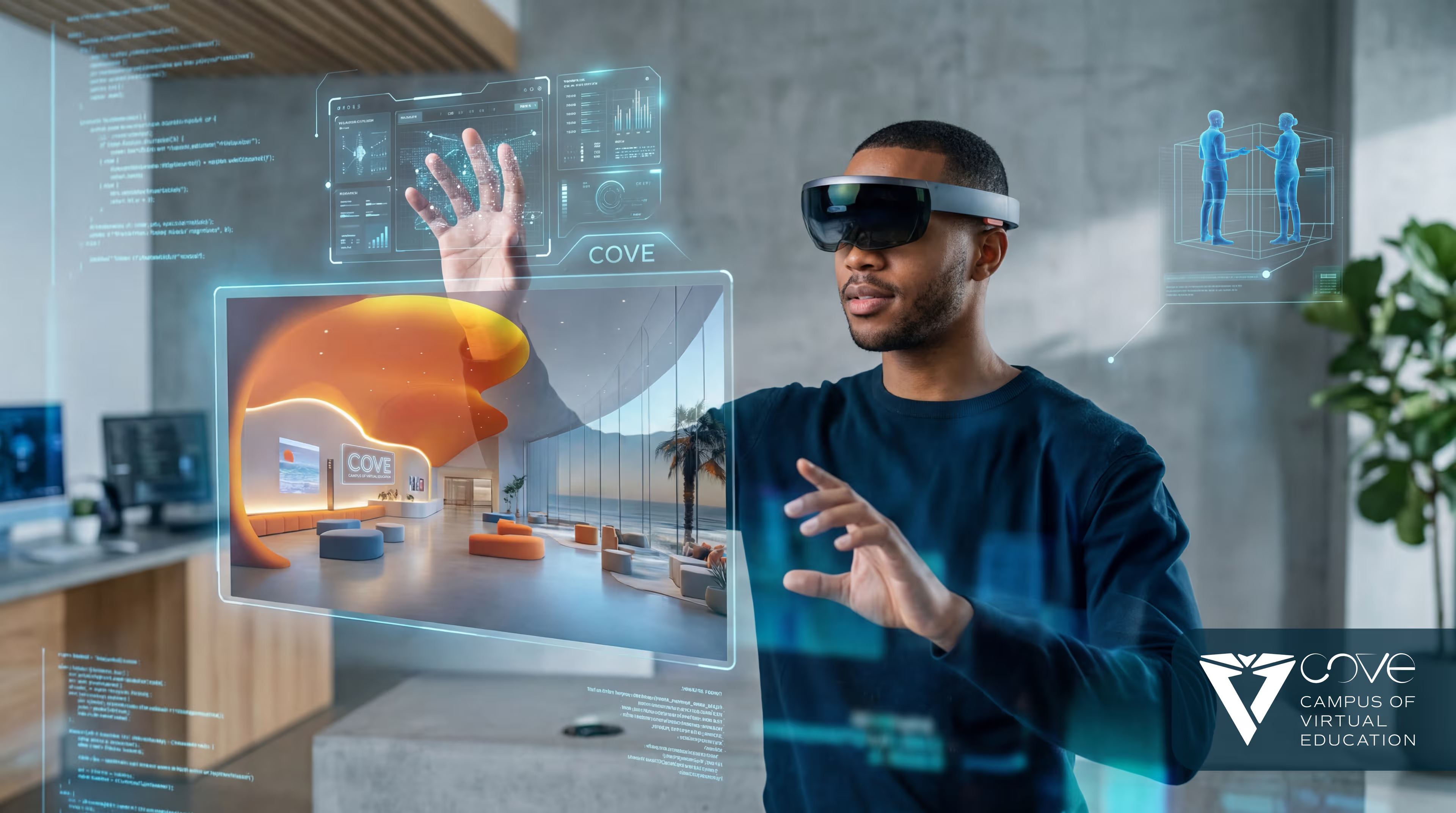
Campus Of Virtual Education
Experience Learning In Our Immersive Virtual Campus
Four Dimensions of a Unique Position
German UDS does not compete with MIT or Stanford on their own turf — it fills a strategic gap: the globally accessible, fully digital, state-accredited space for AI-integrated entrepreneurship that established institutions are structurally unable to occupy.
Fully Digital Entrepreneurship College
Startup training without geographical boundaries: globally accessible and directly connected to the digital campus. State-accredited and globally accessible without being tied to a specific location.
AI-Native Startup Methodology
AI is systematically integrated into analysis, development, validation, pitching, and scaling — with critical AI literacy so students understand that AI accelerates the process but does not replace entrepreneurial judgment.
Cross-Program Integration
Entrepreneurship connects all degree programs and fosters interdisciplinary venture teams that combine technology, market understanding, regulation, leadership, and implementation skills.
Virtual Incubator COVE
COVE transforms the university into a digital startup space featuring mentoring, co-creation, and real-world application — the virtual campus becomes an incubator for international teams.
Roadmap 2026–2028
A three-phase path from curricular integration through COVE incubator development to establishment as a European benchmark for AI-integrated digital entrepreneurship.
Foundation
Officially launch the virtual campus, introduce a mandatory entrepreneurship module in all twelve degree programs, establish an AI startup coaching system, & build the first mentor network with 20+ members.
Expected outcome: entrepreneurship fully integrated into the curriculum, COVE operational, mentoring network active.Phase 2 · 6–18 months · 2026–2027
First ten founding teams in the COVE Incubator, a VC partner network with five or more funds, an AI Entrepreneurship Lab as an independent course unit, and internationalization through the first partner university.
Expected outcome: active startup teams, established VC network, international presence.Visible impact
Twenty-five or more active startups from the German UDS ecosystem, the first successful exit or major funding round, a European network of digital entrepreneurship universities, and the publication of high-impact research findings.
Expected outcome: publicly visible success story, established network, empirical research agenda.
Where AI, Digital Science, and Venture Creation Come Together
The vision for 2030: German UDS as Europe's leading digital entrepreneurship ecosystem, with 100+ startups from the alumni network and a global community of founders from 50+ countries. Those who make these decisions shape the future. Those who postpone them leave it to others.