
MBA Digital Law (available soon)
Lead the change in the digital era!
Program Details
- Duration: Online, One year, 4 Quarters, 60 ECTS
- Language: English
- Fees: €7,500
Tuition Payment Options
Starting September 1st, 2025 we offer 2 options for the tuition payment:
- Yearly payment: the program fee of 7500 EUR needs to be paid at once and before the study program starts.
- Quarterly instalment payment: under this payment plan, the tuition fee per year is 8000 EUR, and the quarterly instalment fee of 2000 EUR needs to be paid no later than the 15th of the month prior to the quarter start.
*Kindly note that our quarters start on January 1st, April 1st, July 1st, and October 1st.
Entry requirements
- Relevant professional experience in a digital environment of at least three years
- University degree or higher education qualification
- English Level B2 (CEFR) or equivalent
Study Access
Overview
The MBA Digital Law program at the German University of Digital Science (German UDS) is designed to provide executives and decision-makers who work at the intersection of law, technology, and business with the competencies required to effectively oversee digital transformation in a world characterized by platforms, data, and artificial intelligence. The program establishes a connection between advanced legal thinking, technological innovation, and practical managerial tools for strategy, compliance, and governance in digitally driven organizations. The curriculum is meticulously designed to integrate the fundamental domains of digital law, encompassing areas such as data protection, AI regulation, platform law, ecommerce, fintech, and robotic law. This integration is achieved through a systematic approach, ensuring a cohesive and practice-oriented educational experience.
The central ambition of this endeavor is not merely to impart isolated legal rules for novel technologies, but rather to cultivate a systemic understanding of the way digital infrastructures, business models, and regulatory frameworks interact and coevolve. Graduates acquire the skills necessary to design and implement legally robust, innovative-friendly solutions in complex environments. They are also able to anticipate regulatory trends, such as the EU's digital strategy, AI Act, DSA/DMA, Data Act, and GDPR. Furthermore, graduates are equipped to translate these regulatory trends into corporate governance, risk management, and product development. In accordance with the mission of German UDS, the program integrates academic rigor, digital delivery, and societal responsibility. It prepares professionals to shape a humane, democratic, and sustainable digital order rather than merely reacting to technological disruption.
Program Objectives
- The MBA equips participants with advanced knowledge of digital law, AI regulation, data governance, and platform regulation in the context of global digital economies.
- It enables professionals to understand and shape digital infrastructures and services as regulated socio-technical systems.
- The program prepares leaders to translate regulatory requirements into practical digital architectures, processes, and business models.
- Graduates develop the expertise to navigate evolving legal frameworks and ensure compliant, secure, and trustworthy digital innovation.
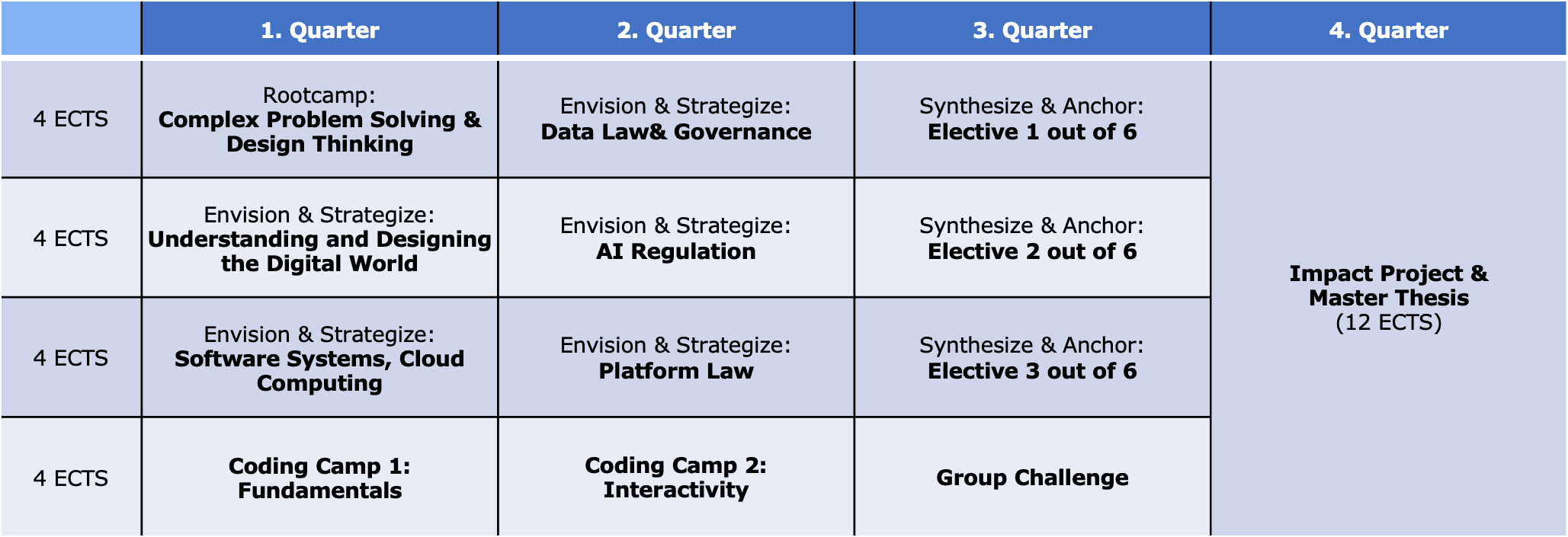
Exemplary Study Program
Electives
Benefit from our large pool of electives and take the opportunity to specialize individually in your field of interest.
A special feature of our degree programs is the great freedom of choice. While students on each study program must take 50% of the elective modules from a specified subject area designed specifically for the individual study programs, the rest can be chosen freely from the entire electives pool.
- E-Commerce Regulations
- Consumer Protection in E-Commerce
- Metaverse & Virtually Reality Law
- FinTec Law
- Robotic Law
- Anti-Fraud & Complience
Unique Features
- Combines legal expertise with technology and business perspectives, including design thinking, software fundamentals, and cloud computing basics.
- Focuses on emerging regulatory frameworks such as the EU AI Act, Digital Services Act, and Digital Markets Act and their impact on digital markets.
- Provides interdisciplinary training that enables professionals to integrate legal compliance into the design of digital platforms, services, and data strategies.
- Positions law as a strategic driver of innovation, trust, and sustainable digital business models, rather than a purely reactive constraint.
Why study this MBA?
- The MBA provides a comprehensive understanding of AI regulation, platform law, and data governance, preparing professionals to navigate complex digital legal frameworks.
- The program combines academic research with real-world regulatory practice, including case studies and interaction with experts from regulators, courts, law firms, and technology companies.
- Graduates gain the expertise to manage compliance, anticipate regulatory risks, and shape responsible digital innovation in rapidly evolving technology markets.
Why German UDS?
- At the German UDS, the students combine theory and critical thinking with practical experimentation and application.
- Throughout the years, the students learn from pioneering thought-leaders and work with internationally significant industry partners.
- This collaboration allows the students to create innovative work in virtual and extended realities.
- The German UDS provides an extensive online toolset that allows you to succeed with your studies.
Career Outlook
- Graduates of the MBA in Digital Law gain strong career opportunities at the intersection of law, digital technologies, and strategic management in technology-driven industries and global organizations.
- The program prepares professionals to navigate complex regulatory frameworks for AI, platforms, and data governance and translate them into organizational policies, contracts, and governance structures.
- Graduates are equipped to lead interdisciplinary teams in designing and implementing innovative yet compliant digital solutions.
- Typical career paths include positions such as Head of Digital Compliance, Chief Data Protection Officer, AI Governance Lead, Platform Policy Manager, Legal Product Owner, or Regulatory Affairs Manager.
- The combination of legal expertise, technological literacy, and leadership capability also opens opportunities in supervisory authorities, international organizations, and board-level advisory roles in the digital economy.
.png&w=1080&q=75)
-1.png&w=1080&q=75)